
Process control, energy and maintenance
Manufacturing
Your inputs are not a specification. Moisture, particle size, composition and temperature move with the supplier, the season and the load, and every machine downstream absorbs that variation. When the process drifts or a fan starts to vibrate, you find out from a trip rather than from a trend, because the number that would have warned you is either not recorded or not trusted.
What goes wrong, and what it costs
- An input arrives outside spec and nothing downstream is told
- The line works harder than the product needs, and the extra energy goes onto the bill rather than into a quality report. Back the process off instead and you trade energy for scrap.
- A blend or recipe drifts because nobody is measuring the mix
- Two properties move together, so one machine draws more current and the next is running against material it was not set up for. Output looks fine until it does not.
- Condensation in the gas path after a stop
- Below dew point, dust stops being dust and becomes a wet cake that builds unevenly on fan blades. Restart with that on a rotor and you have an imbalance measured in tens of kilonewtons per revolution.
- Vibration climbing over weeks, closed as separate events
- A sawtooth trend that resets after each clean and returns higher is fatigue accumulating. The failure looks sudden on the day and was months in the making.
- A sensor channel that has quietly stopped moving
- The worst failure mode in the list, because it hides the others. A frozen channel reporting a comfortable value is worse than no channel at all: it produces false confidence exactly when risk is highest.
Where the energy goes
In an energy-intensive plant the largest controllable cost is the energy spent making variable inputs behave like consistent output. Thermal work dominates it, mechanical work follows, and both are set by material you did not choose. Every step of Koidra attacks the same number from a different side. Essentials meters energy per tonne and shows the drift. Maintenance Management protects the equipment whose degradation quietly wastes it. AI Advisory says which shift and which batch ran hot. KoPilot holds the process at the operating point that costs least.
What process plants have in common
A discrete assembly line and a continuous process plant look nothing alike, and they fail the same three ways.
The inputs vary and the line absorbs it. A conventional thermal plant buys a specification. Most manufacturers buy whatever the market has this month: a different grade, a different moisture, a different particle size, sometimes several mixed in one pile. That single fact propagates through everything downstream, and a plant that treats its input as constant will be wrong several times a day.
The cost surfaces as energy per tonne, not as an alarm. Nothing trips. The line keeps running. The drift shows up on a utility bill a month later, by which point nobody can say which batch or which shift it came from.
The equipment degrades on a schedule nobody plots. Rotating machinery announces itself for weeks before it stops. The announcements get closed one at a time as separate events.
Where we go deepest
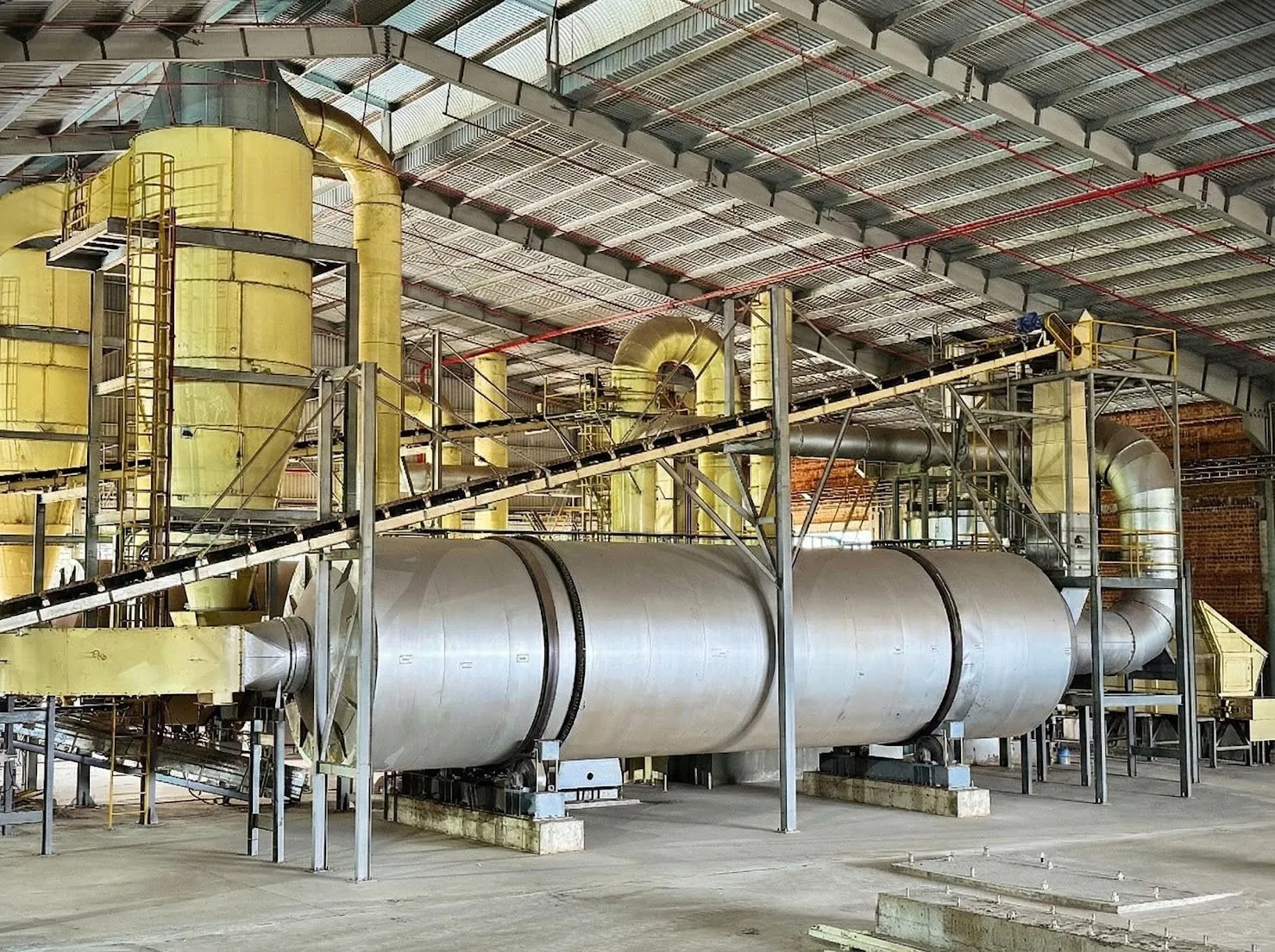
Energy-intensive manufacturing and energy production, because that is where the three patterns above cost the most and where our own operating experience sits. Dryers, mills, boilers, kilns, furnaces and the thermal utilities around them. Wood pellet production is the worked example through the rest of this page, since it is the line we know best and the one our customer writes root cause analyses about.
The same loop applies wherever a physical process turns variable material into a specification: food and beverage, building materials, pulp and paper, chemicals, rendering, and the energy plants that supply them.
Three things worth instrumenting properly
Input quality, before it becomes someone else’s problem
Moisture measured at intake, not inferred from how hard the dryer is working. Grindability tracked against mill current so the relationship is visible rather than folklore. Blend ratio recorded per production batch, so when output drops you can ask what was different about that run and get an answer.
The dew point margin nobody watches
Dryer exhaust temperature usually has a setpoint chosen for product quality and a floor nobody wrote down: the dew point of the gas leaving it. Run below that floor and moisture condenses in the ductwork and on fan blades. Wet dust cakes where dry dust would have fallen away.
The margin also disappears whenever the line stops. Gas paths cool far below dew point within a shift, so a plant can be inside spec while running and outside it every time it stops. Two plants running identical equipment can have opposite reliability records purely because one holds a wider margin and the other has drifted twenty degrees below it over several months without anyone flagging it.
Combustion and heat, following a material that moves
Boiler or burner control tuned for one material is being asked to hold temperature and air ratio against another. Where the physics is well understood, that is a control problem worth automating, and it is what KoPilot does.
Sensor health is a maintenance item
This is the one most plants have not internalised, and it is the reason trends get ignored.
Instrumentation degrades quietly. A vibration channel reads consistently low against a handheld meter. A temperature channel freezes on its last value and reports a comfortable number for hundreds of hours while the real surface sits far below it. Neither shows up as a fault. Both are trusted for decisions.
Koidra watches the channels as well as the process. A tag whose standard deviation is zero for hours while its equipment is running is not a stable process, it is a dead sensor, and it should raise an alarm of its own.
Failures announce themselves for weeks
The pattern behind most expensive breakdowns is not a sudden event. It is a sawtooth: vibration climbs over days, resets when someone cleans, returns higher, and repeats for months. Each cycle is millions of revolutions under load, and each individual alarm looks survivable, so each is closed on its own.
Seeing that requires two things a spreadsheet cannot give you. History long enough to show the shape, and the maintenance record on the same timeline as the sensor trend, so a repeated work order stops reading as bad luck and starts reading as a signal.
That is the whole argument for putting it in one place.
Proof
Ayo Biomass runs on Koidra across multiple sites, and its dryers gained 20% in operational efficiency after a two-phase KoPilot deployment. The failure modes on this page are the ones their engineers actually write root cause analyses about, generalised to the sector and stripped of anything specific to one product line.
What we measure here
- energy per tonne
- process drift
- production batch
- dryer outlet temperature
- dew point margin
- mill current
- combustion air ratio
- preventive maintenance completion
- sensor health
See Koidra on your plant data
Bring a week of readings from one line. We will show you what the platform sees, what it would have flagged, and what it would have scheduled.
Book a demo