
Step 1 of five
Essentials
Every signal the plant produces, in one place, live and historical.
Most plants start here or at Maintenance Management. Tell us what you already instrument and we will scope it.
Replaces
- The control-room panel
- Screenshots sent over messaging apps
- Paper clipboards and shift logbooks
- Spreadsheets nobody maintains
- A standalone historian
Pays for itself by
Replacing the paper log, the messaging-app screenshot, and the week of trend history that used to vanish. Catching a drift before it becomes a trip.
The number a buyer checks: Unplanned downtime avoided, and hours a week not spent assembling reports.
What sits in Essentials
Essentials is the plant’s memory. It takes every value the site produces, whatever the source, and puts it under one clock and one equipment tree.
- Process and energy signals. Whatever your programmable logic controllers and meters already publish, at whatever rate they publish it.
- What people record by hand. Shift logs, quality checks, moisture readings, downtime notes. Entered on a phone at the machine rather than typed up later.
- Photographs. Equipment condition, a leak, a finished pallet, attached to the asset and the moment rather than sitting in someone’s camera roll.
- Production batches. A run, a campaign, a crop cycle. Everything above hangs off it.
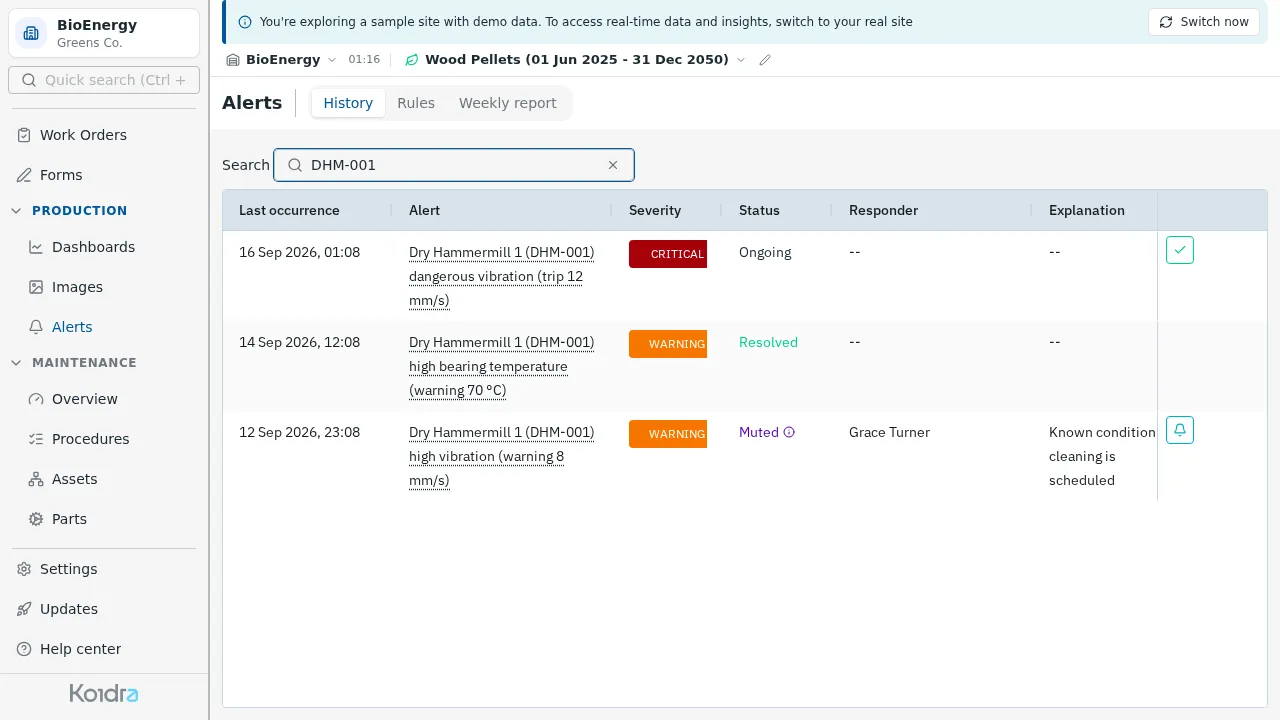
- Alarms and notifications. Thresholds that reach whoever is on shift, on the device they carry.
Why holding both kinds of data in one shape matters
Most plants already have their sensor data somewhere. What they do not have is the operator’s moisture reading sitting next to it, in the same shape, against the same equipment.
Koidra stores continuous machine data and occasional human data as the same kind of thing. One consequence is worth stating plainly, because it is the part competitors cannot copy without rebuilding: an alarm can fire on a number a person typed. A historian never sees the operator. A maintenance system never sees the trend.
That is also what makes the steps above this one possible. A work order cannot be raised by a trend unless something is watching the trend. A weekly report cannot say what changed unless it can see both the sensor and the shift note.
What you can stop doing
Standing at the panel to read a value. Screenshotting a chart into a group chat. Keeping a parallel spreadsheet because the historian only holds a week. Asking three people what happened on Tuesday night.
Where this sits
Four steps to autonomous operations. Each one is a complete product with its own payback, and each makes the next possible. Read the full ladder.
-
STEP 1
Essentials
Every signal the plant produces, in one place, live and historical.
-
STEP 2
Maintenance Management
The system decides what maintenance is due, dispatches it, and tracks what it cost.
-
STEP 3
AI Advisory
Reports that arrive without being asked for, saying what changed and what to look at.
-
STEP 4
KoPilot
Closed-loop control of the process, minute by minute, with no human at the panel.
Next step: Maintenance Management. The system decides what maintenance is due, dispatches it, and tracks what it cost.
See Koidra on your own plant data
Bring a week of readings from one line. We will show you what the platform sees, what it would have flagged, and what it would have scheduled.
Book a demo